
Seventeen people were declared dead at a tavern in Extension 3, Wedela, on Gauteng's West Rand on Saturday night after eight unidentified gunmen unleashed coordinated rifle fire across the venue. Police say the assailants arrived at approximately 21:30, opened fire on patrons drinking outside, then moved through the interior doors and continued shooting.
The attackers carried pistols and AK-47 assault rifles. Investigators allege that during the assault, several patrons were searched and stripped of their cellphones before the gunmen fled in two unidentified vehicles. Two cars parked near the scene were set alight. Emergency medical personnel declared 13 men and four women dead on the scene, while 15 other people suffering from gunshot wounds were rushed to nearby hospitals across the West Rand.
By Sunday morning, Gauteng police had registered 17 counts of murder, 15 counts of attempted murder, and two counts of malicious damage to property. Captain Tintswalo Sibeko confirmed that provincial detectives and specialised operational units had been mobilised for a priority manhunt. No suspects were in custody, and police stated that the motive remained unknown.
That official phrasing carries heavy implications. An attack that begins on a street frontage, penetrates an interior social space, systematically harvests communication devices, and torches transport vehicles is not an escalated tavern brawl. It reflects tactical execution, military-grade firepower, and deliberate exit management in a densely populated township precinct. Treating an unknown motive as an endpoint rather than an urgent investigative question obscures the operational realities of public violence.
South Africa has repeatedly absorbed mass casualty shootings across township taverns, informal settlements, and private residences. Reciting body counts without interrogating the flow of automatic weapons, ballistic traceability, and regional intelligence gaps reduces catastrophic loss to routine bookkeeping. A manhunt launched twelve hours after eight armed men depart into the dark requires scrutiny over road closures, vehicle checkpoints, and physical evidence recovery.
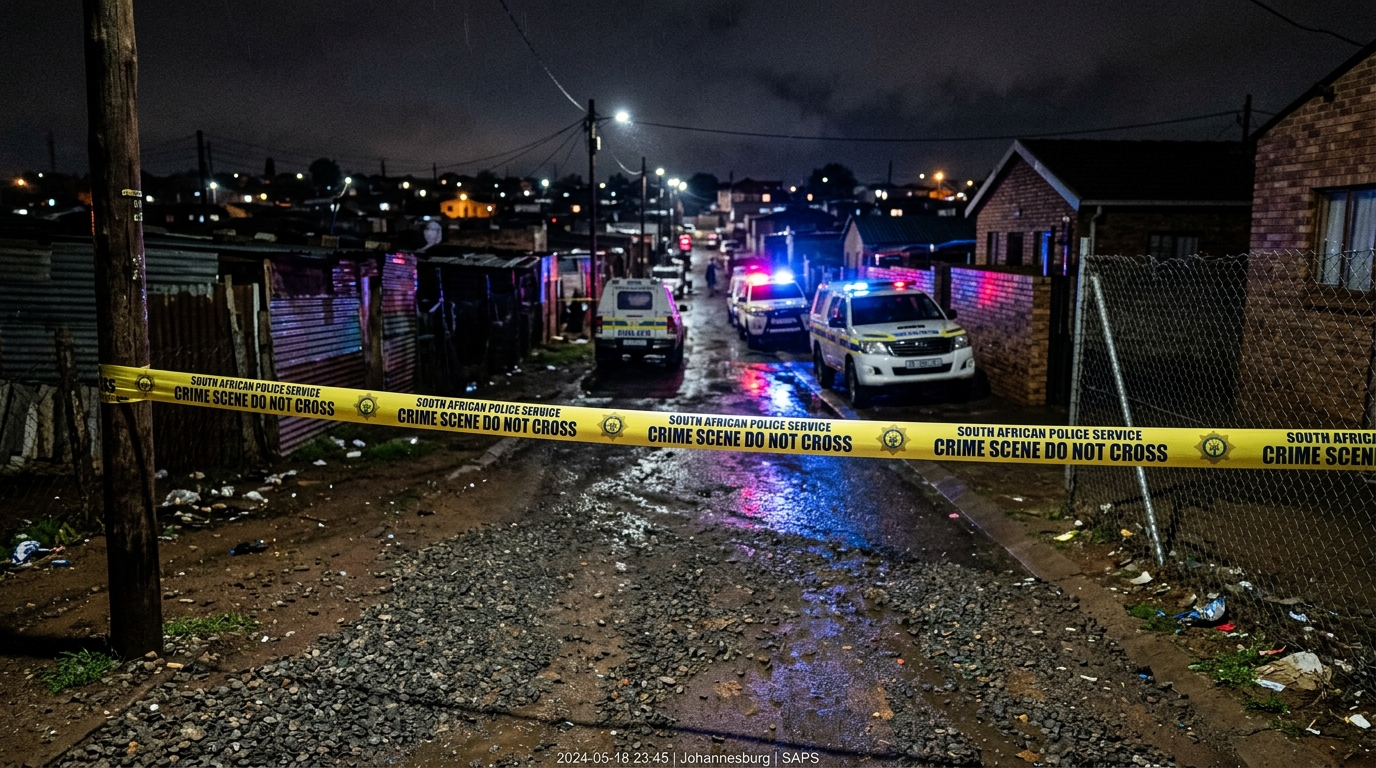
This incident constitutes a planned mass shooting inside a community recreational venue utilizing military-pattern assault rifles, accompanied by systematic phone confiscation, vehicle arson, and an immediate getaway.
Until SAPS recovers ballistics, identifies the getaway vehicles, or brings named suspects before a magistrate, public assurances of a provincial manhunt remain a holding line. The defining reality is that eight individuals wielded automatic rifles in an open social venue on a weekend night, eliminated 17 lives, wounded 15 others, and exited without immediate interception.
For communities across the West Rand and the broader mining and commuter belts, evening leisure and local hospitality operate under continuous personal risk. Commercial taverns and neighbourhood venues are foundational to township micro-economies, yet they remain structurally exposed to armed syndicates operating outside visible police visibility.
For the families of the 17 deceased, Sunday morning began with the harrowing administrative process of mortuary identification, while families of the 15 hospitalised victims wait on clinical updates that could still shift the fatality count.
* Where did the AK-47 assault rifles originate, and do ballistic markings match historical cash-in-transit, mining conflict, or gang dockets in Gauteng?
* Do investigators possess functional CCTV footage, automated number-plate recognition data, or forensic vehicle tracking from the escape route, or does the docket rely solely on eyewitness recall?
* With 15 wounded victims receiving emergency trauma treatment, what immediate clinical and security measures are in place at receiving regional hospitals to protect surviving witnesses?