Eight accused individuals, including seven municipal revenue and electricity technicians and 25-year-old contractor Janitha van Reenen, are set to return to the Vanderbijlpark Magistrate's Court on 26 October 2026 facing charges over a systemic R9.9 million electricity reconnection and debt-erasure syndicate inside Emfuleni Local Municipality.
The state alleges that between February 2024 and June 2026, the syndicate intercepted heavily indebted industrial, commercial, and property consumers facing municipal disconnection across Vanderbijlpark and Vereeniging, taking illicit cash bribes directly into personal accounts while tampering with essential infrastructure to draw unmetered power from South Africa's most financially distressed municipal grid.
Van Reenen, who previously appeared on an unrelated R424,000 municipal account discount fraud charge, was dramatised by a high-profile re-arrest outside the Vanderbijlpark Magistrate's Court on 3 September 2026 by operatives of the SAPS Gauteng Political Killings Task Team. Her arrest followed the team's deployment into the Vaal corridor following the 30 March 2026 assassination of internal municipal finance whistleblower Martha Mani-Rantsofu, who was shot dead execution-style after flagging corrupt municipal payment runs, ledger tampering, and an ongoing R16 million vehicle procurement investigation.
On 18 September 2026, the court granted Van Reenen R20,000 bail, placing her on the same terms as her seven municipal co-accused: David Senekal (31), Caroline Smangele Maduna (39), Kenneth Zongezile Mahobe (35), Hlawutelo Baloyi (29), Pule Meshack Masilo (36), Andries Bafana Maduna (48), and Sibusiso Patrick Tshabalala (46). All eight face counts of fraud, money laundering under the Prevention of Organised Crime Act, theft of electricity, and the tampering with or destruction of essential infrastructure under the Criminal Matters Amendment Act 18 of 2015.
HOW THE INSIDER POWER PIPELINE OPERATED
The mechanics of the syndicate rested on an operational pincer movement combining physical hardware sabotage on the street with administrative sabotage on the municipal billing ledger.
When Emfuleni Local Municipality's credit-control teams disconnected commercial sites that owed hundreds of thousands of rands in unpaid utility bills, syndicate intermediaries approached the business owners. Rather than settling statutory arrears at municipal customer service centres, clients were instructed to deposit illicit service fees or cash kickbacks—exceeding R150,000 in directly traced payments—into private personal bank accounts belonging to syndicate members.
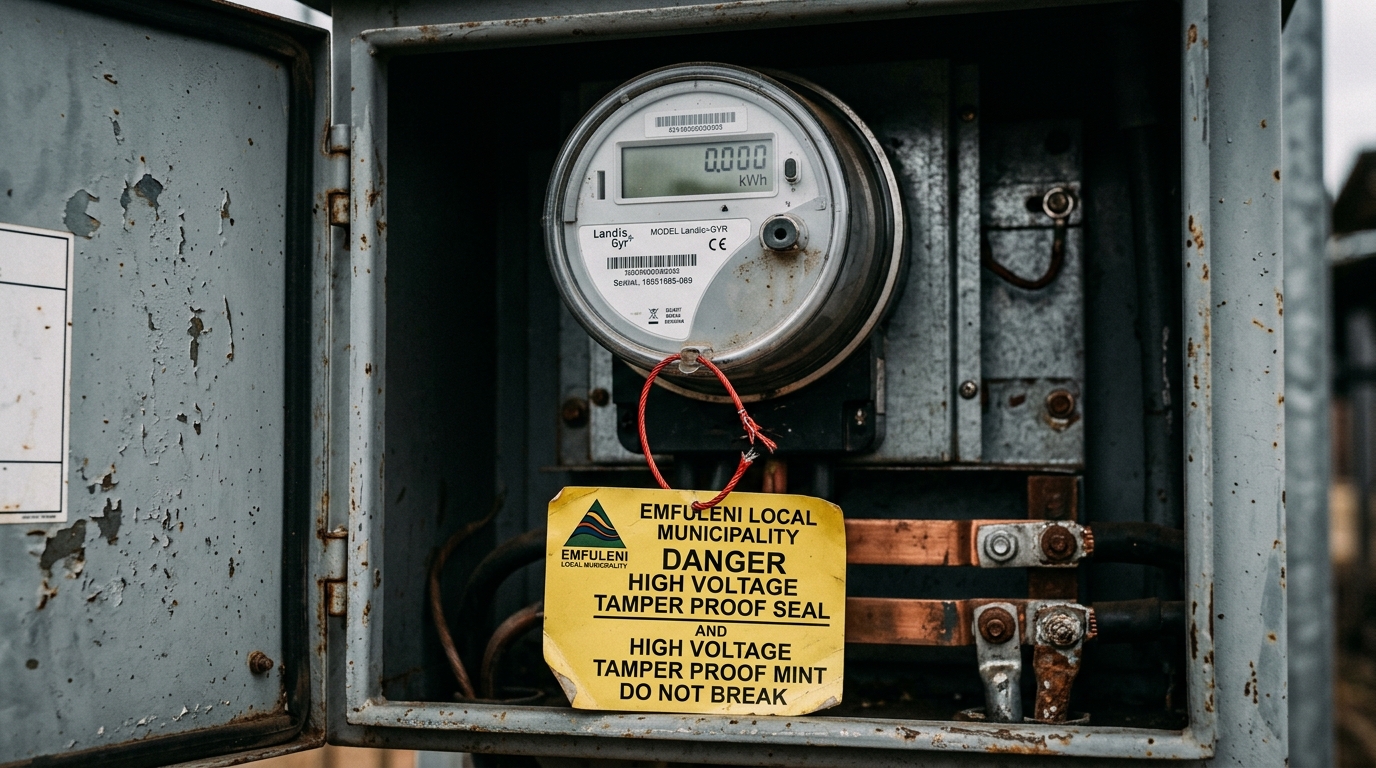
Once payments cleared, municipal electricians and technicians deployed municipal tools and official credentials to bridge-wire smart meters, sever municipal tamper-proof seals, and reconnect heavy-voltage feeds directly to the substation grid. Simultaneously, co-accused staff inside the revenue department accessed internal enterprise databases, inputting false credit adjustments, fictitious payment references, or temporary dispute overrides.
The data manipulation temporarily suppressed automatic billing disconnection flags on the municipality's server. While external financial reconciliation and automated system audits eventually flagged the phantom credits—causing the original debts to rebound onto consumer statements months later—the physical bypasses remained in place on site, granting commercial premises uninterrupted, unmetered electricity without municipal revenue recovery.
THE STRUCTURAL COLLAPSE OF THE VAAL GRID
The criminal scheme unfolded against the backdrop of Emfuleni's total financial collapse. The municipality, which oversees Vanderbijlpark, Vereeniging, Sebokeng, and Evaton, remains South Africa's single largest municipal defaulter, with historical Eskom liabilities exceeding R8 billion and total creditor debt breaching R10.8 billion.
In September 2024, Eskom obtained high court attachment orders against Emfuleni's primary bank accounts, seizing revenue streams to recover unpaid bulk electricity accounts. To prevent the complete shutdown of basic municipal operations, national Treasury and the courts forced the municipality into a landmark Distribution Agency Agreement, yielding electricity revenue collection and technical maintenance directly to Eskom.
While ordinary, paying residents in working-class townships endured recurring load reduction, blown transformer substations, and aggressive cut-offs, an internal syndicate was privatising municipal electricity infrastructure for commercial gain.
For residents and business operators in the Vaal corridor, the court proceedings mark a pivotal shift in how municipal sabotage is prosecuted under South African law.
First, the application of the Criminal Matters Amendment Act 18 of 2015 signals that municipal infrastructure tampering is being treated as an offense against national economic stability, carrying severe statutory penalties of up to 30 years' imprisonment rather than minor municipal by-law fines.
Second, the involvement of the Gauteng Political Killings Task Team confirms that municipal corruption in Gauteng has crossed into dangerous territory, where whistleblowers risk targeted violence for exposing ledger tampering and procurement cartels.
Third, commercial consumers who paid bribes to buy illegal reconnections face mounting exposure. Prosecutors and forensic auditors are tracing banking records, and businesses caught utilizing illicit municipal bypasses face severe back-billing, permanent infrastructure confiscation, and potential criminal co-liability for receiving stolen state services.
Will the National Prosecuting Authority extend its indictment to include the commercial business owners who funded the syndicate's personal bank accounts to obtain unmetered electricity?
Can Eskom's takeover of Emfuleni's distribution agency successfully seal administrative billing vulnerabilities and physical meter tampering across the Vaal triangle?
What evidentiary links, if any, will the Political Killings Task Team establish between internal utility cartels and the targeted assassination of whistleblower Martha Mani-Rantsofu when the trial resumes on 26 October 2026?